
WeCOPE: Express Gratitude, Notice and Savor
Over the last year, I’ve been deeply involved in a new program called WeCOPE (Connecting with Our Positive Emotions). Over the course of seven one-hour sessions, WeCOPE helps people develop skills and practices that research shows improves overall well-being, physical health, stress levels and happiness. Thanks to a partnership with the state and federal departments of agriculture, we have also begun the process of creating a farm and rural version of WeCOPE that will include activities, case studies and other content specific to the lives and needs of farmers, their families and others in rural communities.
I’m excited to share in this article the highlights of one of our seven WeCOPE modules; it covers the practices and skills associated with expressing gratitude, noticing and savoring. I grew up on a very rural Midwestern family farm and know firsthand that many people practice gratitude weekly or even daily. Expressing our thanks and appreciation is one way of living out our religious beliefs, whether we do so by giving thanks before a meal or pausing to observe the wonder of a calf being born or tiny corn plants emerging through the early spring soil. This time of year, gratitude often takes center stage as we celebrate the holidays, families and traditions.
Unfortunately, as simple as it is to practice gratitude, we too commonly neglect to do it. I’m guilty of this myself. Even when I speak to farm audiences about stress, I often start by talking about the litany of stressful things that are common in agriculture.
Through the WeCOPE program, participants learn that the expression of gratitude is an extremely powerful skill. The positive emotions we experience as we practice the act of expressing gratitude displace negative emotions. Medical research has shown that people dealing with serious illnesses respond to care and treatment more positively when they express gratitude. They also experience less pain and fewer associated symptoms.
Gratitude can be expressed in a number of ways, whether toward other people, objects in nature, or through spiritual beliefs. There are countless examples; just a couple include writing notes about things you’re thankful for and talking about them with others. Many people find joy in sharing photos with friends and loved ones, or simply spending time together. The regular practice of gratitude can reduce levels of anxiety and lessen the negative impacts associated with depression. The benefits – which have been proven repeatedly – include improved sleep quality, greater satisfaction with life and stronger, more meaningful connections with family and friends.
Two additional skills related to expressing gratitude are noticing and savoring. As it relates to this particular WeCOPE module, “noticing” refers to slowing down for a few moments throughout the day and noticing or focusing on something positive that’s happening in your midst. We often think we’re too busy to pause, but when we slow down and use all our senses to notice what we see, feel, smell, hear and taste, our lives are richer for it. As a result, the things we’ve purposely noticed give us an opportunity to practice gratitude.
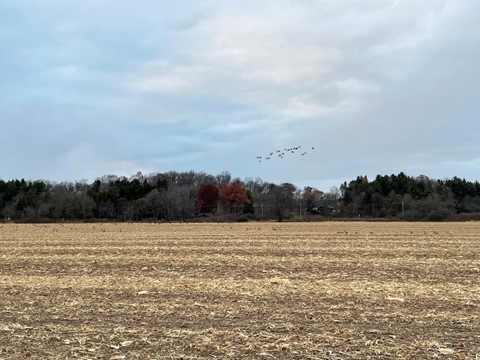
Let me share an example: The other day, while at home in rural Dane County, I needed to take my car in for an oil change before work. The mechanic’s shop is a half-mile away, so I drove there and walked back home. The sun had just risen; it was cold, windy and blustery. As I walked home, I noticed the huge group of geese that had landed in a nearby cornfield. They were hunkered down in the cornstalks, taking advantage of the tree line that borders the Black Earth Creek to shelter from the north wind.
I forced myself to stop and observe. The geese were several hundred yards away but I could hear their enthusiastic honking with clarity. I could smell the freshly harvested field and soil – in an instant I was transported back in time, remembering all the sensations of running the combine on cold November mornings. I found myself thinking about the generations of geese that had probably landed in that same field over the last 60 years of my life. I wondered what their destination would be and if it was warm where they were headed.
While standing there that blustery morning, growing cold from the biting wind, I yearned a little for the warmth of summer. At the same time, I also felt gratitude for the beauty of our changing seasons. In my moment of pause, a smile came onto my face as I recalled my late father piling my sisters and me into the car to “go look at the geese” as Mom made our Thanksgiving meal. It was code for “getting the kids out of the kitchen” during the times of holiday chaos for parents with a young family. Back then, as a nine-year-old, standing in the cold wind, watching a bunch of geese honk noisily in the nearby wetlands was not my favorite thing to do. But that was more than 50 years ago. Flash forward to today, and that couple minutes spent noticing those geese brought a big smile to my face (and heart!) as I reflected on those days with my dad and little sisters with profound gratitude.
Savoring is the third skill in this WeCOPE module. Think of savoring as a way to slow down and extend the positive impact of what you’re noticing. It can also be thought of as turning up the volume of positive emotion by amplifying an event. How often have you eaten a good meal and because you were rushed you never really noticed the flavors or textures of it. Maybe a couple hours later you’ve even forgotten what you ate earlier.
Just as we can savor food we can savor experiences, and it’s a way to fully embrace the good you’ve made the effort to notice. Savoring helps you maximize the positive impacts on your health, stress levels and overall sense of well-being.
Again, as with expressing gratitude and noticing, it can be helpful to share your extend-and-savor experiences with others through a quick call or text message. Or you could take a picture and post it on social media along with your thoughts, feelings and expressions of gratitude. As I referenced at the start, these are some things I’d learned to do from my family while growing up on the farm. Little did I know how impactful they would be for my health and well-being. I encourage you to give it a try.
If you’d like to learn more about the “ag” version of the WeCOPE program and how to further develop practices like noticing and savoring – or others such as goal-setting, mindfulness and self-compassion, send me a note at shutske@wisc.edu. You’ll begin to see more information on this program early in 2022, and we’re excited to offer it in our rural and farming communities statewide!
*The original WeCOPE program is supported by a grant through the U.S. Substance Abuse and Mental Health Services Administration (SAMHSA), and the farm/agricultural adaptation is sponsored by a generous grant through the U.S. Department of Agriculture (USDA) through a special partnership with the State of Wisconsin’s Department of Agriculture, Trade and Consumer Protection.
About Author
A professor and extension specialist with the UW–Madison Department of Biological Systems Engineering and UW–Madison Division of Extension, and director of the UW Center for Agricultural Safety and Health